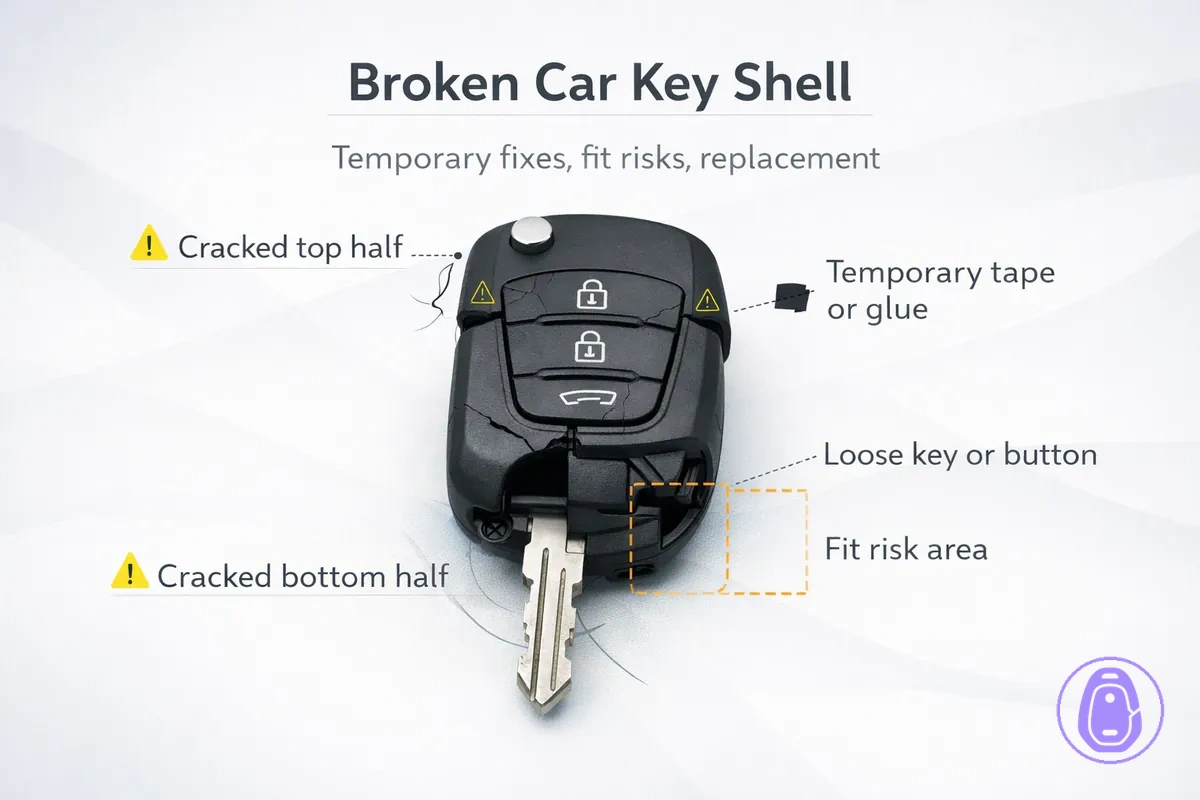
Broken Car Key Shell: temporary stabilization, fit risks, and replacement triggers
A broken key shell is damage to the key fob shell or housing that holds internal parts. Cracks often form along seams or at the closure point where the blade joins the plastic. Daily twisting in the ignition can stress this spot and weaken the material over time.
The housing may fail to close properly, exposing components. These effects are typically limited to physical shell damage, separate from electronic symptoms.
See if a temporary fix can stabilize your broken key shell for short-term use or if you should replace it due to fit risks like wobble, gaps, or misalignment. Button function issues include uneven travel, accidental presses, or problems at pressure points. Go Back to troubleshooting hub.
- When a temporary fix is reasonable (short-term stability, no new fit issues).
- When replacement is safer (closure/retention failure or unreliable button actuation).
What a broken key shell is, and what problems come from other parts
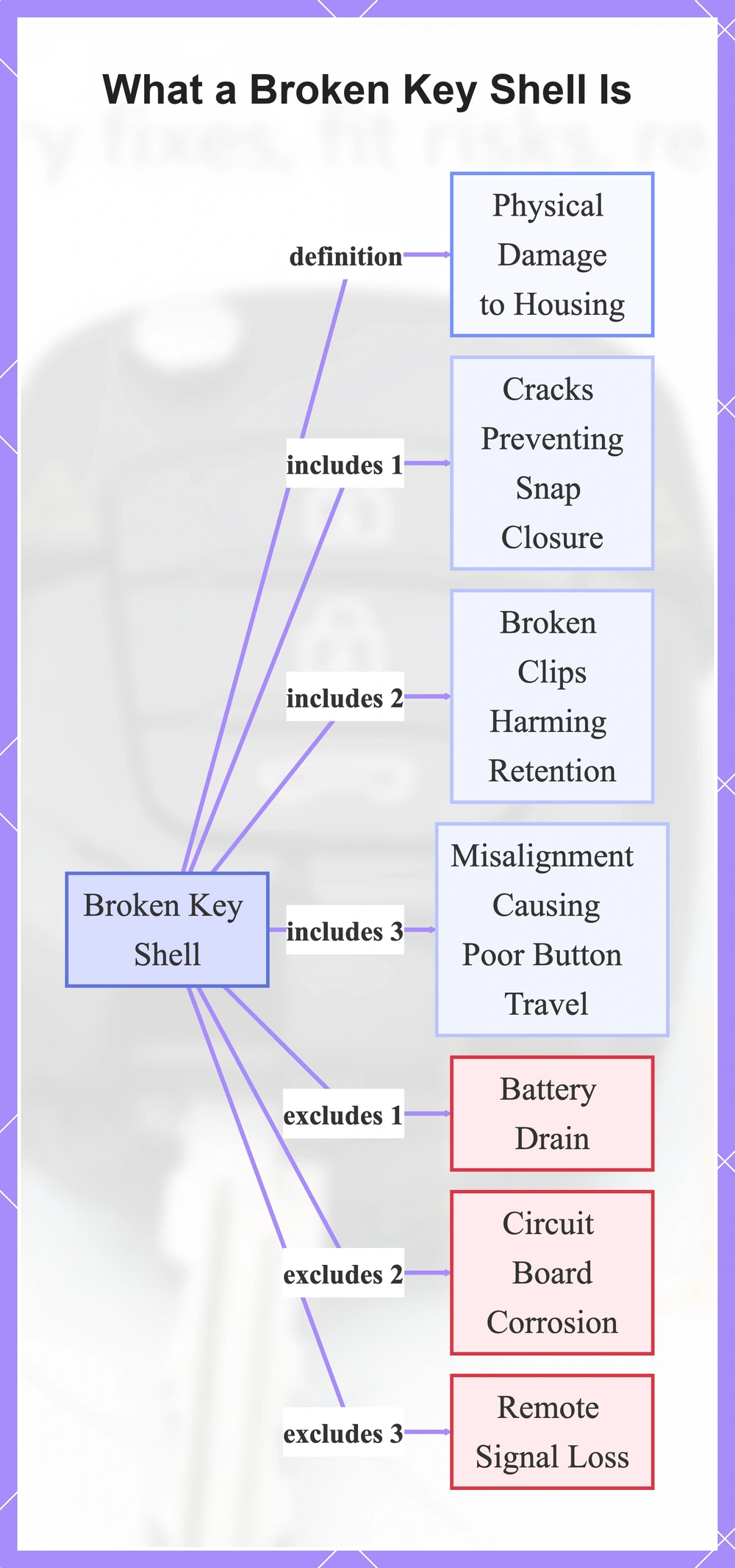
A broken key shell is physical damage to the housing that keeps the key components together. Cracks often form along seams in the housing from wear, drops, or twisting stress. Such physical damage can affect closure, retention, alignment, or the button interface.
Owners often mistake housing cracks for electronics failure, but a broken key shell results from plastic becoming brittle over time. Shell damage affects the housing interface; it does not by itself change remote programming.
- In scope: cracks or splits in housing that prevent snap closure.
- In scope: broken clips or screw posts that harm retention of internals.
- In scope: misalignment causing poor button interface travel.
- Out of scope: battery drain or circuit board corrosion.
- Out of scope: immobilizer or remote signal loss.
This flowchart defines a broken key shell, its core meaning, included mechanical issues, and exclusions for other failure types.
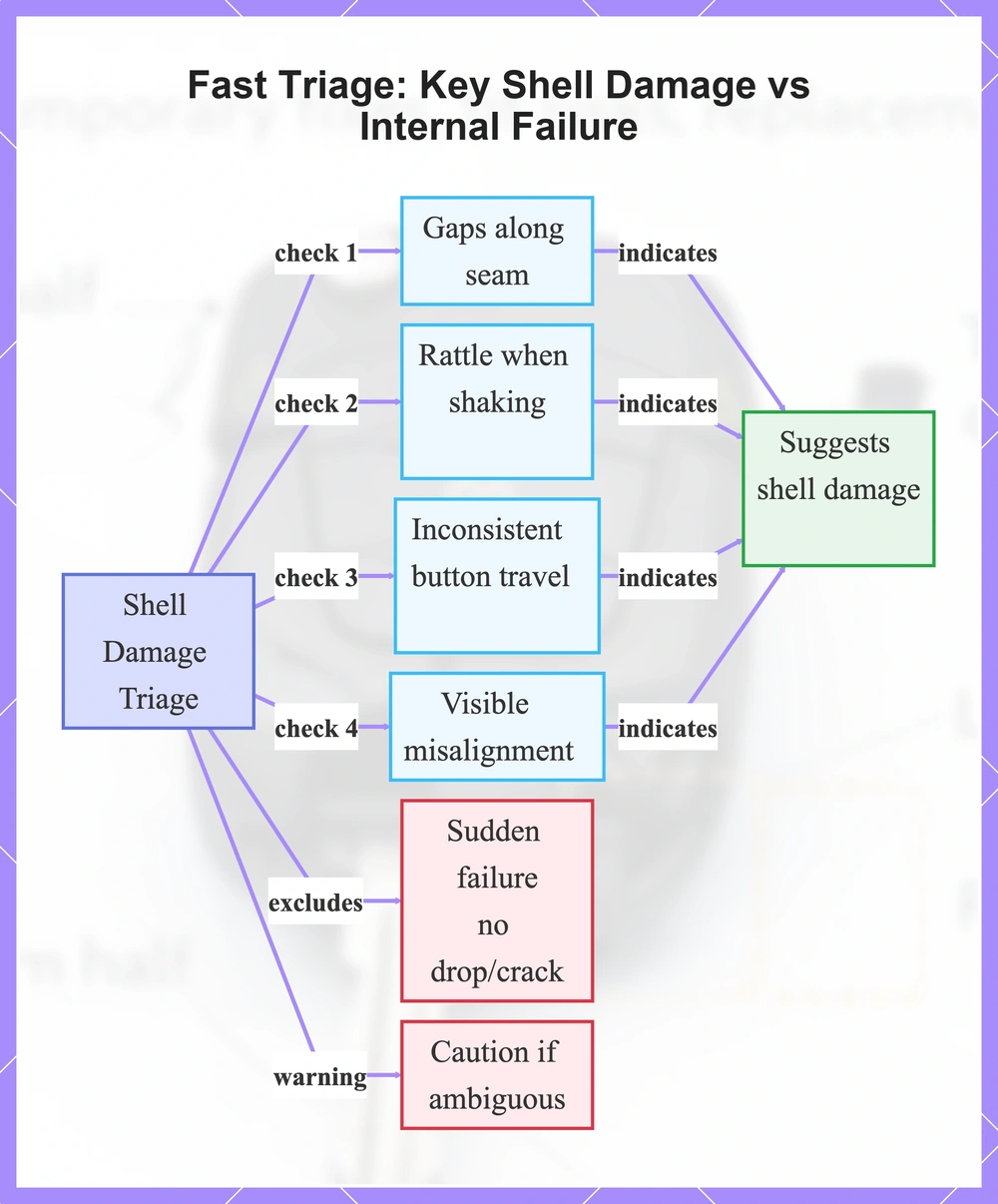
Fast triage: shell damage versus internal or electronic failure signals
Triage your car key shell with observable checks that point to shell damage over internal or electronic failure. Look for physical signs like changes after a drop to separate shell problems from other issues. These checks show if misalignment or rattle lines up with symptom onset, no tools needed.
- Inspect closure integrity for gaps along the seam or uneven closure after a drop.
- Listen for rattle or loose sound when shaking, which suggests internal movement or wobble.
- Test button travel for inconsistent resistance or actuation under normal pressure.
- Look for visible misalignment or shift in shell parts near symptom onset.
- Feel for loose play or internal movement in components during handling.
- Check for wobble around buttons that ties to a crack or physical shift.
A key drop that causes immediate rattle and more resistance in button travel from a shell shift suggests shell damage. Sudden button failure without a drop, crack, or visible misalignment fits less with shell damage.
Ambiguous signals may overlap with internal or electronic issues, so use caution before blaming the shell.
This flowchart shows observable checks that indicate car key shell damage over internal or electronic failure signals.
Physical damage patterns that predict how the key will behave
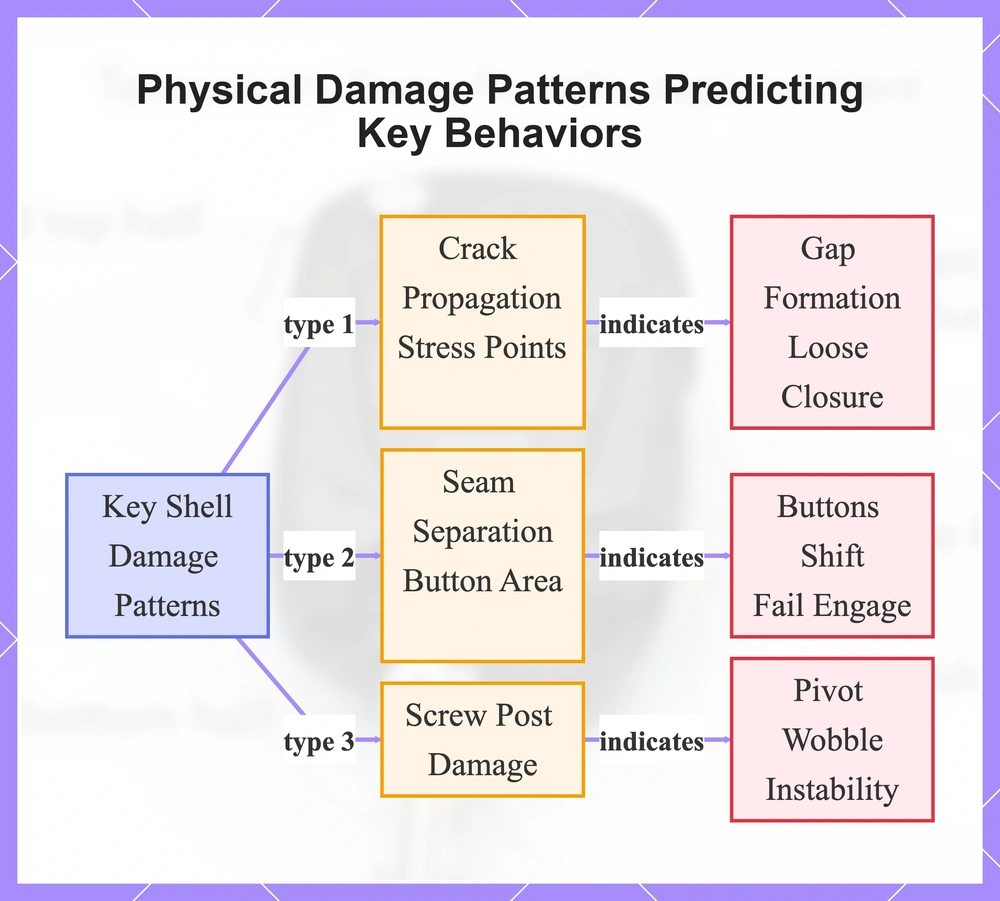
Damage patterns in the key shell housing predict behaviors like wobble or insecure closure. Crack propagation tends to spread from stress points, weakening the structure. Seam separation often creates visible gaps that compromise fit.
Repeated flex or pressure creates visible damage patterns that lead to retention failures at clips or screw posts. Retention points may lose grip, causing misalignment at the hinge or pivot. Cosmetic scratches may change appearance, while structural damage can impair closure and fit.
- Crack propagation along side seams can spread under pressure, predicting gap formation and loose closure.
- Seam separation near the button area tends to weaken retention points, potentially causing buttons to shift or fail to engage.
- Retention point failure at clips may lead to incomplete snap shut, with parts separating during insertion.
- Screw post damage often correlates with wobble in the pivot, reducing stability when inserting the key mechanism.
- Hinge instability from repeated flex predicts misalignment, making the shell feel loose in hand.
- Clip detachment in the button area can weaken pressure response, potentially altering button activation behavior.
This flowchart shows key physical damage patterns in the key shell housing and the specific behaviors they predict, such as wobble or insecure closure.
Cracks, split seams, and corner breaks that spread under pressure
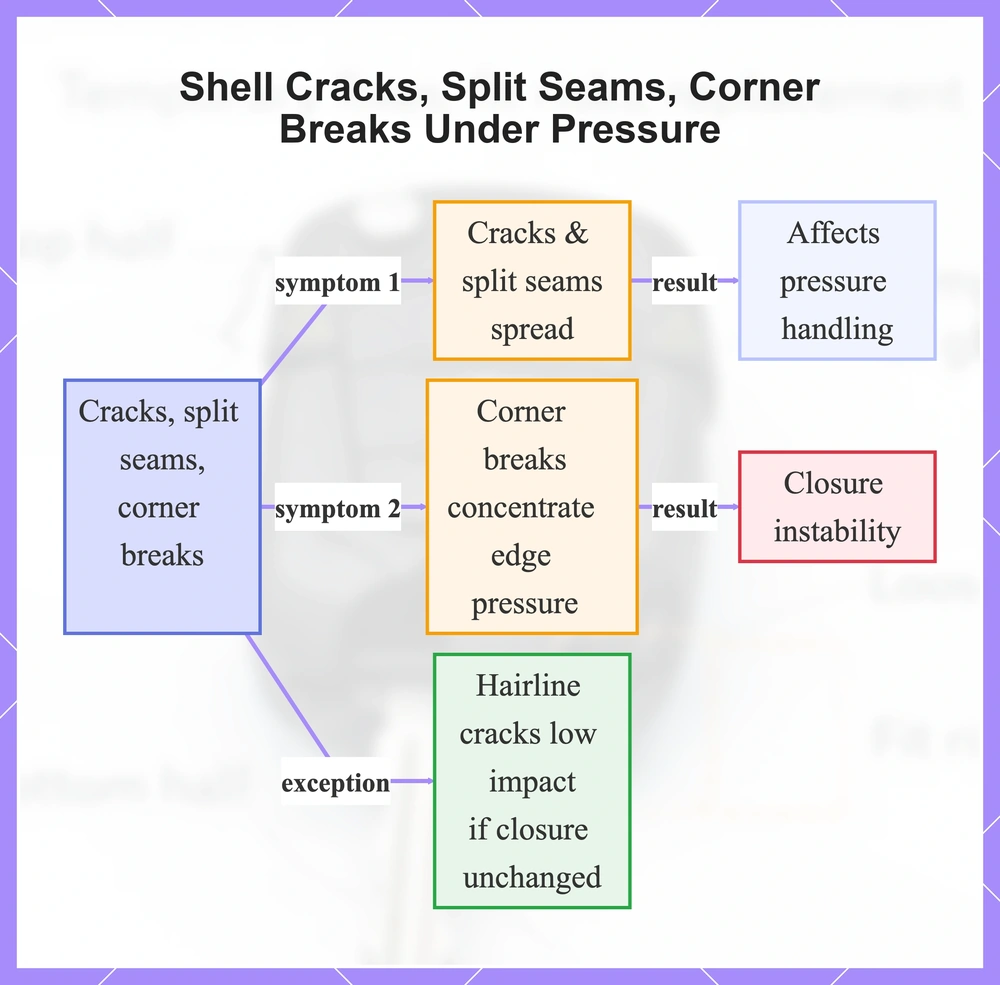
Cracks and split seams can spread under pressure, which affects how it handles pressure during use. Corner breaks concentrate pressure at the edges, leading to closure instability.
Hairline cracks can have low impact if closure and button behavior remain unchanged.
- Seam cracks from pocket pressure spread, causing closure instability during insertion or removal.
- Split seams from repeated opening and closing weaken bonds, raising the risk of full separation under twist.
- Corner breaks from drops shift pressure unevenly, creating unstable handling and escalation risk.
- Cracks near seams concentrate pressure, promoting spread that affects button retention.
- Corner breaks with twist forces heighten closure instability under repeated handling.
This flowchart shows the key behaviors and risks of shell cracks, split seams, corner breaks under pressure, including low-impact hairline cases.
Clip, screw-post, and hinge failures that prevent proper closure
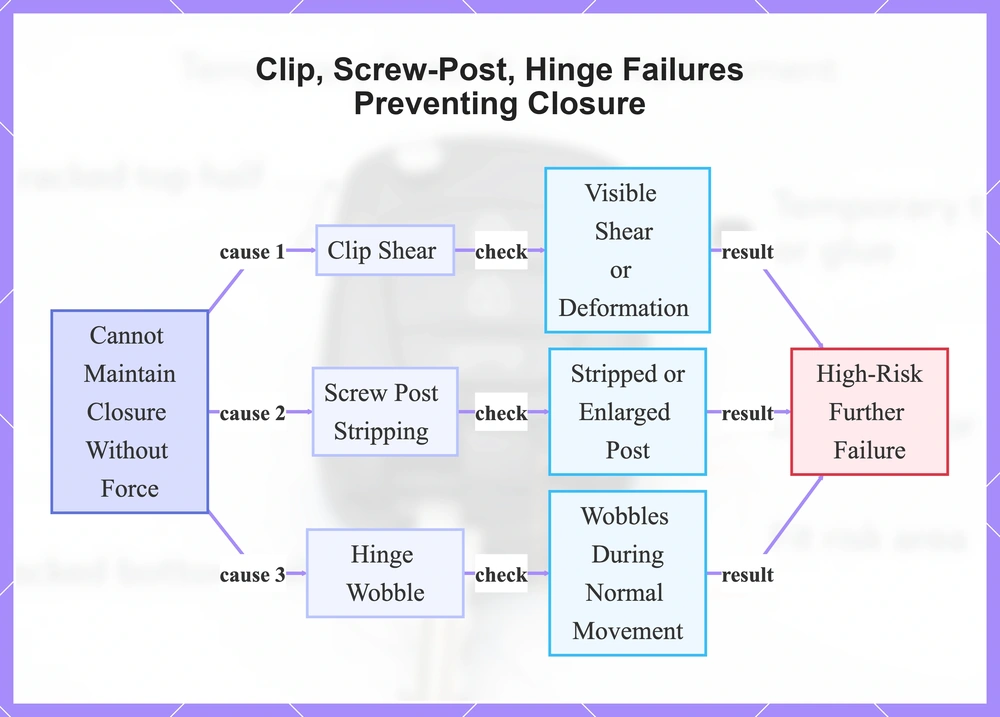
Clips, screw posts, and hinges serve as retention points that secure closure. Failures in these areas prevent proper closure and lead to recurring reopening, looseness, or misalignment during use. Clip shear lets the shell pop open, screw post stripping causes looseness, and hinge wobble creates gaps and misalignment. If closure cannot be maintained without forcing pressure, treat it as high-risk for further failure.
- Shell pops open under light handling from clip retention point failure.
- Clip shows visible shear or deformation that prevents closure.
- Screw post looks stripped or enlarged with noticeable looseness.
- Hinge wobbles during normal movement.
- Gaps appear around the hinge from misalignment.
- Missing fasteners let parts shift and reopen.
This flowchart diagnoses common retention point failures causing improper closure, key identification checks, and high-risk outcome.
How a broken shell changes button feel, travel, and reliability
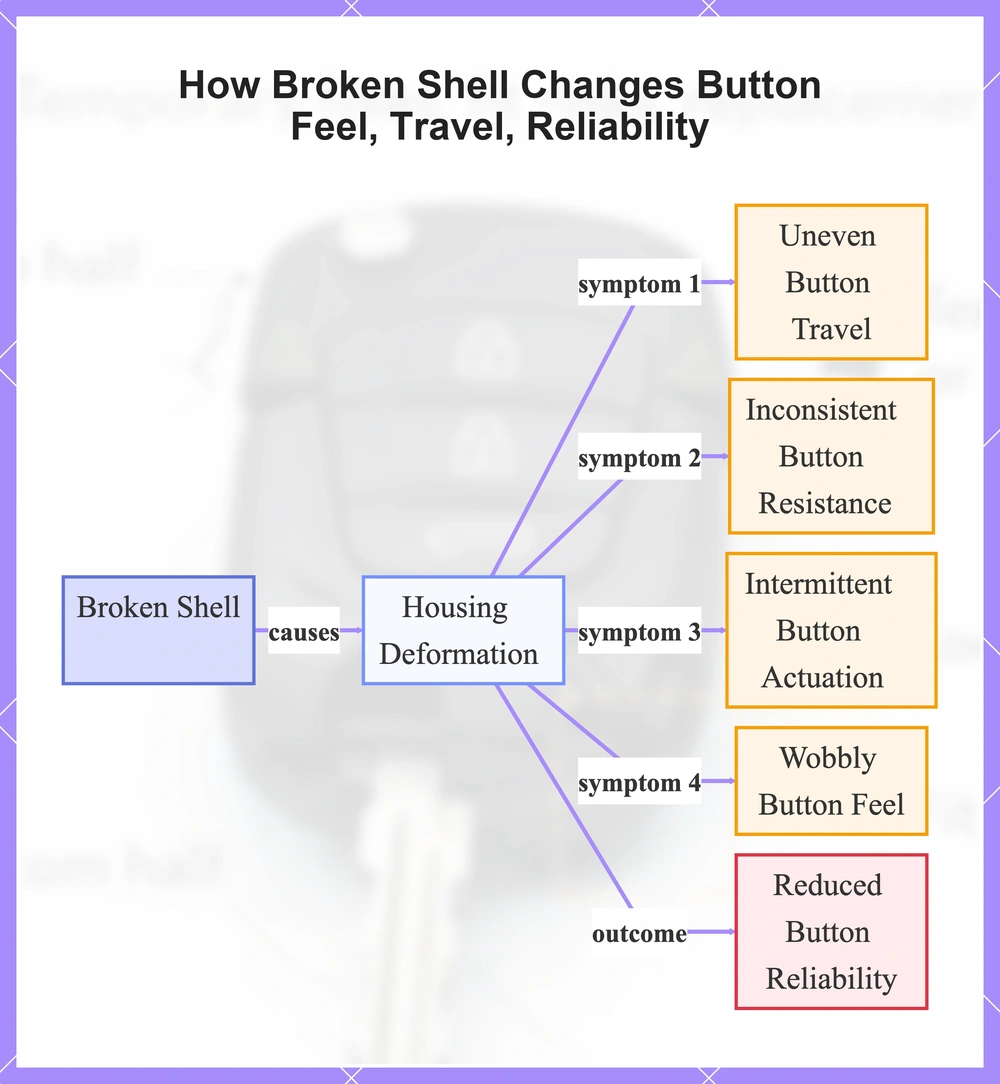
A broken shell can deform the housing, changing button feel, travel, resistance, and actuation. Cracks or warps disrupt even pressure on buttons, leading to uneven travel and inconsistent resistance. The shell holds components in place for stable button function, and that’s why these changes happen.
- Uneven button travel from housing misalignment shifting button positions.
- Inconsistent resistance from shifted pressure points along button edges.
- Intermittent actuation from internal movement causing on-and-off contact.
- Accidental press from gaps or loose seams allowing unintended presses.
- Changed button feel from wobble due to poor closure and fit.
- Reduced reliability from fluctuating actuation as fit shifts during handling.
- Sticky resistance from seam deformation pressing on buttons.
Picture a key fob shell cracked from a drop, where buttons show intermittent actuation and uneven travel. Housing deformation causes internal movement that mimics failing button symptoms. You may notice it after impact, but refer to the earlier triage criteria if symptoms point to multiple issues.
This flowchart shows how a broken shell deforms the housing, disrupting button pressure and causing key symptoms like uneven travel and reduced reliability.
Misalignment and pressure points that cause stuck, weak, or accidental presses
Misalignment in the car key shell creates pressure points that disrupt button function, causing stuck buttons, weak presses, or accidental activations. Warped halves or uneven seam closure can produce gaps that alter contact pressure on the button pad.
Misalignment produces an inconsistent button feel that changes with shell position, while true electronic faults tend to persist regardless of shell position. Persistent stuck buttons despite alignment fixes may indicate a non-housing issue.
- Warped halves that misalign seam closure, forming gaps and pressure points which can cause stuck buttons when pressed.
- Shifted button pad seating that limits travel and causes weak presses from insufficient contact pressure.
- Uneven seam closure creating variable pressure points that can trigger accidental presses on nearby buttons.
- Internal component movement that alters button pad position, producing inconsistent weak presses or accidental activations.
Temporary fixes that reduce movement without worsening fit
Temporary fixes stabilize broken key shells in the short term by limiting wobble, reducing internal movement, and supporting seam alignment and closure fit. Take conservative approaches to preserve button function while avoiding pressure points that spread cracks or force misalignment. Warning: Fixes that trap seams, block buttons, or force closure risk further damage to alignment and internal components. Do not proceed with any temporary fix that worsens fit or compromises button function.
- Inspect seams for gaps and gently compress the shell to reduce wobble; confirm closure aligns properly and buttons have full travel.
- Apply light external pressure evenly around the seam to stabilize alignment; confirm fit remains snug without new gaps or pressure points.
- Secure loose areas minimally to limit crack spread and internal movement; test button function after each adjustment to ensure no blockage.
- Monitor wobble with shell closed; confirm alignment and fit do not shift under light handling.
- Reassess closure geometry and button response after short-term stabilization; discontinue if any resistance or looseness appears.
- Increased wobble or gaps mean worsening fit; stop and escalate immediately.
- Blocked buttons or reduced travel indicate pressure points; stop the fix right away.
- Forced closure causing seam distortion means heightened risk; halt and seek professional evaluation.
- Accidental button presses from restricted movement require stopping to prevent further misalignment.
- Any spread in cracks despite stabilization shows failure; discontinue as a stop signal.
Stabilizing a cracked shell while keeping seams and buttons functional
- Do an alignment check for seam flush and closure fit before stabilizing the crack.
- Stabilize the crack while avoiding added thickness near button edges and verifying actuation.
- Do another alignment check for seam flush and closure fit after stabilizing.
- Monitor the crack under normal handling with alignment checks for seam flush and closure fit.
Stop if button travel changes or seams no longer close evenly.
Holding a Shell Closed When Retention Points Are Failing
When retention points fail, hold the shell closed with alignment-first strategies to minimize internal movement and accidental opening. These keep shell halves aligned to avoid gaps or wobble while minimizing torsion and pressure that compresses buttons.
- Perimeter wrap: Align shell edges flush first, then apply even wrap; check for torsion buildup and button compression.
- Wedge insert: Slide thin wedge into edge gap after alignment; check if it reduces internal movement without button pressure.
- Band loop: Loop bands around aligned halves; check for gaps at retention points.
- Lever brace: Apply brace against edges after alignment; check if it avoids compressing buttons or causing wobble.
- Cord tie: Tie cord to keep aligned sections shut; check for accidental opening risk and button fit changes.
- Edge clamp: Clamp outer edges lightly after alignment; check for reopening at retention points or internal shift.
If holding the shell closed requires pressure that changes button behavior, treat it as a failure condition; it risks accidental presses or reopening. Escalate if wobble or gaps return under light handling, signaling closure stabilization is no longer dependable.
Fit risks from a damaged housing and why they escalate quickly
Damage to the key shell housing can alter tolerances. This leads to fit risks like gaps, wobble, seam mismatch, internal shifting, and misaligned buttons. These changes create pressure points even when electronics keep functioning. Fit risks escalate quickly as repeated use turns minor misalignments into secondary failures.
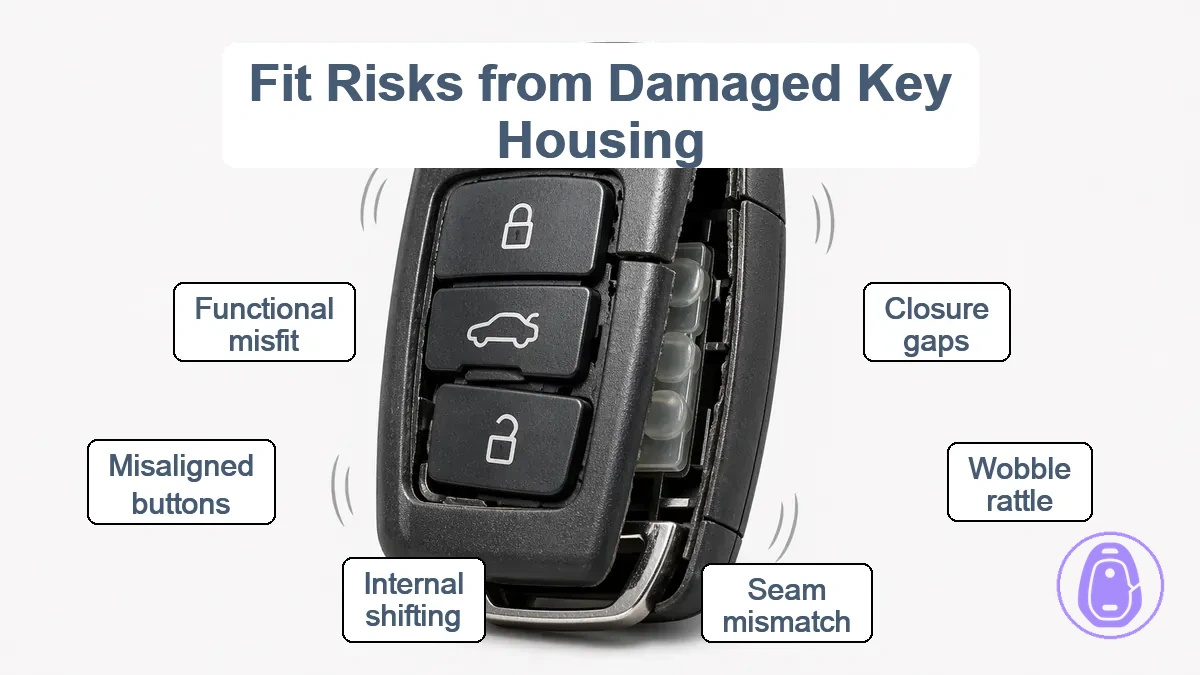
- Gaps around closure let debris in, which may cause internal shifting and wear.
- Wobble causes ongoing movement and rattle, stressing components over time.
- Seam mismatch creates uneven pressure points that promote cracks during handling.
- Internal shifting leads to secondary failures in sensitive electronics.
- Misaligned buttons cause accidental presses and poor travel response.
People often think fit risks pose no problem if buttons respond. Poor tolerances can still trigger secondary failures. Outcomes vary by design variance and damage severity; review Compatibility checks to assess risks early. Use these observable checks to separate cosmetic misfit from functional misfit:
- Cosmetic misfit involves appearance-only cues like minor gaps with secure closure and normal button behavior.
- Functional misfit shows in closure or button behavior, such as wobble and internal shifting.
Gaps, wobble, and internal shifting that create secondary failures
Gaps, wobble, and internal shifting in a car key shell can lead to secondary failures during normal handling. They trigger uneven compression, seam reopening, and stress concentration points that may worsen over repeated use, potentially causing accidental presses or intermittent actuation. Minor wobble may be tolerable if closure and button behavior remain stable. Movement that changes button feel between presses signals a functionally unstable fit.
- Gaps can cause seam reopening during handling, leading to internal shifting and accidental presses.
- Wobble can produce uneven compression on buttons, potentially resulting in intermittent actuation.
- Internal shifting from wobble can trigger stress concentration, which may worsen over repeated use.
- Uneven compression may lead to stress concentration points and intermittent actuation.
Repair versus replace: criteria that decide the safer choice
Repair vs replace criteria for broken car key shells weigh risk, repeatability, and reliability to pick the safer choice. Retention integrity, button reliability, and fit stability serve as the main criteria. These factors decide if short-term stabilization holds or issues escalate to replacement, depending on damage type and usage intensity.
| Repair (stabilization) suits: | Replace (swap) when: |
|---|---|
| Good retention integrity with firm closure and minimal looseness on repeat reopening | Retention integrity compromised, repeated reopening causes looseness |
| Button reliability maintained, minimal travel changes or pressure points from fixes | Button reliability compromised, pressure points risk accidental presses |
| Fit stability maintained, minimal gaps or wobble after temporary adjustments | Fit stability lost, gaps and internal shifting persist despite efforts |
A shell with a hairline crack that holds good retention integrity and minimal wobble on repeat reopening allows short-term stabilization to buy time, as long as it avoids new pressure points before escalation. Deep splits differ, as shifting internals compromise button reliability; temporary fixes may then alter fit or button reliability, favoring replacement. If criteria point to replacement, check the Replacement hub for next steps.
When the shell can be stabilized temporarily without creating new problems
Temporary stabilization is acceptable for short-term use if it passes pass/fail checks right after the fix.
A fix that holds but changes button feel counts as a reliability failure.
- Shell achieves stable closure without excessive force.
- Unchanged button actuation: no noticeable change in travel or reliability.
- No new noticeable gaps along shell seams.
- No detectable internal movement under normal handling.
Replacement triggers: repeated reopening, broken retention, or unreliable button actuation
Replacement triggers escalate when shell issues compromise reliability beyond stabilization efforts, making replacement safer. They point to structural problems that resist correction.
- Repeated reopening where the seam opens multiple times despite cleaning and drying, pointing to closure mechanism problems.
- Broken retention points like fractured clips or screw posts that fail to hold the shell halves together.
- Persistent wobble in the assembled shell that resists tightening without deforming fit, indicating loose internal alignment.
- Unreliable button actuation with inconsistent button travel or misalignment, even after repositioning internals.
- Seam gaps widening after handling, resisting secure latch despite pressure application.
Once these replacement triggers show up, turn to Replacement steps for the replacement process.
Safety and reliability concerns caused by a compromised key housing
A compromised key housing disrupts stable closure and reliable button performance, creating safety and reliability problems in daily use. Risks rise sharply when closure cannot stay shut or buttons actuate unpredictably. Severity depends on the failure pattern and usage context.
- Accidental presses occur when exposed buttons get triggered by misalignment in pockets or bags.
- Drop risk increases if closure failure lets the key slip out while handling it.
- Intermittent operation results from internal movement that disrupts button response.
- Unreliable actuation can delay time-sensitive functions.
- Compromised housing can make it hard to grip securely in wet conditions, heightening safety risks.
Picture a driver rushing to start the car in bad weather. A compromised housing with faulty closure might trigger intermittent operation. That heightens drop risk and chance of loss precisely when time-sensitive entry matters most, but this focuses on housing-driven risks rather than broader vehicle security topics.
Post-fix checks before you rely on the key for daily use
Before you rely on the key for daily use, run these post-fix checks to verify fit and button behavior with observable tests only. Treat the fix as unreliable if a check cannot be passed consistently.
- Press the shell shut to check closure stability; it passes if the seam aligns without gaps or reopening.
- Shake the closed key gently for internal movement; it passes with no wobble, rattle, or shifting inside.
- Press each button fully to verify button travel; it passes if consistent without sticking or uneven pressure points.
- Carry the key in a pocket a few minutes to test for accidental presses; it passes if no buttons activate unintentionally.
- After repeated openings and closings, inspect seams for gaps; it passes if no increasing gaps appear.
- Drop the key from pocket height onto a soft surface to confirm stability; it passes if no new rattles or shifts occur.
If checks fail, escalate: stop daily use and seek replacement resources. Back to troubleshooting hub